Spinner Merge Blitz
- 3.8
- Rating
- 50.00M
- Installs
- Free
- Price

 Analysis by App-foxy
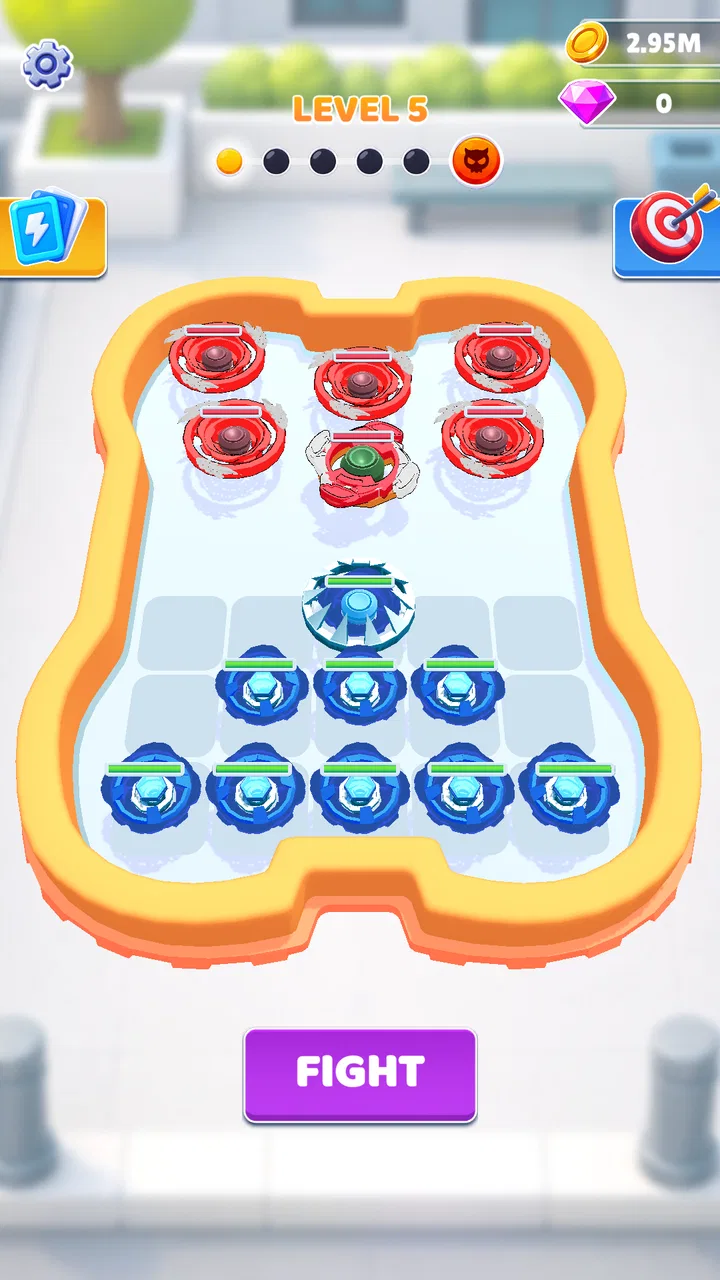
Spinner Merge is the kind of arcade game I can pick up for a few minutes without needing to learn a complicated control scheme. Its central idea is easy to understand: combine spinners, improve the blades around them, and send them into battles where movement and contact decide what happens next. That simplicity is its biggest attraction, but it also means the game depends heavily on how satisfying its progression feels after the first few sessions.
I spent time looking at it as both a quick distraction and a longer-term mobile game. The result is a mixed but generally approachable experience. It is free to start, suitable for Everyone, and developed by Sunday.gg. The game has reached over ten million installs, while its average score sits at 3.8 from roughly forty-nine thousand ratings. Those numbers suggest a broad audience, although they also hint that the experience will not satisfy every player equally.
The most important thing to understand before installing it is that this is not a deep competitive simulator. It is a casual arcade battle game built around short actions, visible upgrades, and the pleasure of watching spinning weapons collide. If you want immediate entertainment and a low learning curve, it has a reasonable chance of fitting your routine. If you want precise esports-style control, extensive strategy, or a carefully balanced long-term multiplayer system, I would set expectations lower.
You May Also Like

 Blood Strike: 2.5 Anniversary
Blood Strike’s Loadouts Turn Every Drop Into a Tactical Gamble
A close look at Blood Strike’s custom loadouts: how fast access to signature weapons reshapes its battle royale rhythm, rewards preparation, and narrows the gap between fights.

 Pandora - Music & Podcasts
Pandora’s Music Is Easy to Start, but Harder to Recover
Pandora’s strength is its low-effort path from a seed to a station. Its weak spot is how much confidence it asks you to place in connection, setup, and quiet recovery.

 8 Ball Pool
 Is Built on Rivalries, Rematches, and Routine
A close look at the rivalries, rematches, shared routines, and unanswered safety questions that turn a quick pool match into a persistent mobile community.

 Samsung Music
’s Quiet Strength Is Playing What You Already Own
Its reach comes less from spectacle than from dependable access to a personal library. That simplicity is both the app’s strongest retention engine and its ceiling.

 AccuWeather: Weather Radar
AccuWeather Review: A Quick, Clear Forecast for Everyday Decisions
For everyday plans, the best forecast is the one you can understand quickly. AccuWeather makes rain timing, radar, and local conditions easy to act on, with a few trade-offs.

 Hill Climb Racing
Why Hill Climb Racing Still Turns Crashes Into One More Run
A tiny car, a bumpy hill and one more upgrade: Hill Climb Racing keeps resurfacing because its simple chaos makes every near-miss feel personal.
More From Our News Desk



How the merging and battles feel in everyday play
The opening minutes are deliberately accessible. You are introduced to the idea of bringing spinners together and turning that combination into a stronger fighting tool. The visual language does most of the explaining: larger or better-equipped spinners look more capable, while the blades make the purpose of each upgrade obvious. I did not need a long tutorial to understand what I was meant to do next.
That clarity makes the game work well in short gaps during the day. I can imagine opening it while waiting for a bus, taking a few turns during a lunch break, or playing briefly before bed without committing to a long session. The controls and objective are simple enough that the game does not punish you for stepping away and returning later with only a vague memory of where you left off.
The merging loop is also more tactile than a standard menu-based upgrade system. Combining pieces gives progress a visible shape, and the spinner itself becomes the result of that work rather than just another number on a screen. That visual connection is useful because it helps me understand why an upgrade matters: I am not merely increasing an abstract statistic; I am building something that will enter the next clash.
Still, the basic loop can become repetitive. Once the novelty of the spinning battles fades, the appeal depends on how much satisfaction you get from incremental improvement. There is no need to overthink every action, but that also means the game may feel light for players who expect each decision to have several meaningful consequences.
Small decisions matter more than the simple controls suggest
One useful way to approach the game is to avoid treating every available merge as an automatic command. I found it more enjoyable to pause briefly and consider whether improving the current spinner would help immediately or whether saving the opportunity would make the next battle feel more worthwhile. That habit gives the otherwise straightforward loop a little more intention.
The blades are especially important to watch. They are not just decoration because they communicate the identity of the fighting spinner and make the result of a merge easier to read. When I focus on how the weapon shape changes rather than only chasing the next upgrade, the progression feels less like tapping through a conveyor belt and more like preparing a tool for a specific encounter.
Another practical tip is to treat short sessions as a strength instead of trying to force a long grind. The game is at its best when I play until the current sequence of merges and battles feels complete, then stop. Stretching that same loop for too long makes its limited variety more noticeable. This is a small distinction, but it changes whether the game feels pleasantly snackable or mechanically repetitive.
Who will enjoy the pace, and who should skip it
I would recommend it to someone who likes casual arcade games with visible progress and uncomplicated battles. It is particularly suitable for players who enjoy combining items, watching an upgraded object perform, and repeating that process without reading complex instructions. The Everyone age rating also makes it an easy recommendation for households looking for a light, accessible game rather than an intense action title.
I would be more cautious with anyone who wants a precise control challenge. The appeal here comes from the merge-and-battle rhythm, not from mastering a demanding control system. Players who prefer elaborate deck building, deep character development, or highly tactical arena combat may find the choices too narrow. A traditional action arcade game would be a better fit if direct reflexes and moment-to-moment control are your main reasons for playing.
It is also not the best choice for someone who dislikes repeated progression loops. The game asks you to accept gradual improvement as the main reward. If you need a strong story, a changing world, or a clear finish line, the spinner format may feel thin after the initial curiosity has passed.
Spending, pressure, and the question of fairness
The game is free to download, but it includes purchases ranging from forty-nine cents to $21.99 per item. That range matters because it places the spending question directly alongside the progression loop. A player can begin without paying, yet the presence of optional purchases means it is sensible to decide in advance whether you are treating the game as a free casual diversion or as something you might spend on.
I prefer approaching this kind of game with a simple personal rule: play the free experience first and only consider a purchase if it solves a specific annoyance rather than an impulse created by a difficult moment. In Spinner Merge, that means asking whether an item would genuinely improve the way you enjoy merging and battling, or whether you are simply trying to remove a temporary feeling of being behind.
The purchase range makes parental awareness worthwhile even though the content rating is Everyone. Age suitability and spending suitability are separate questions. A child may be able to play the battles comfortably while still needing a clear rule about purchases. On a shared device, I would make sure the account’s purchase controls match the family’s expectations before handing the game over.
I cannot fairly describe the competitive balance as fully proven from the purchase information alone. The game clearly offers paid items, but that fact by itself does not establish whether spending creates a decisive battle advantage, speeds progress, or mainly changes convenience. I would therefore avoid calling it either strictly fair or pay-to-win without seeing the exact role of each item during play. The honest position is to enjoy the free loop first and remain cautious about spending until you understand what a purchase changes.
How pressure can change the experience
Free arcade games often create pressure by placing a tempting improvement close to the player’s current goal. In this format, that pressure can be stronger because the object being upgraded is visible and easy to understand. Seeing a spinner become more impressive makes the next improvement feel personal, even when the underlying action is only one more merge.
My advice is to separate progress from urgency. Not every slower moment needs an immediate solution, and not every stronger-looking spinner needs to be obtained right away. If the game remains enjoyable when I ignore the purchase path, that is a good sign that I am playing on my own terms. If the experience becomes frustrating unless I consider paying, it is probably time to close it rather than chase the next upgrade.
This is also where it differs from many traditional arcade alternatives. A classic score-chasing game usually asks me to improve through practice, while Spinner Merge places more emphasis on building a stronger object over time. That can feel more forgiving for casual players, but it may be less satisfying for people who want their success to come almost entirely from skill.
What I would check before committing to long-term play
I would pay attention to three things during the first few sessions. First, does the free progression remain enjoyable when I do not spend? Second, do battles feel like a meaningful test of the spinner I built, or merely a visual confirmation that I upgraded it? Third, does the game give me enough variety to make another session feel different from the previous one?
Those questions are more useful than focusing only on the headline promise of merging and spinning. The core idea is immediately understandable, but long-term value depends on how the game handles repetition and advancement. A player who is happy with a compact loop may find those limits harmless. Someone looking for a constantly expanding system should test the free version carefully before investing money or significant time.
Where it sits among casual arcade games
Compared with a conventional endless runner, Spinner Merge is less about continuous reflexes and more about preparing a stronger object before a confrontation. Compared with a puzzle merger, it adds the excitement of seeing the result enter a battle instead of leaving the reward entirely inside a grid or collection screen. That combination gives it a distinct reason to exist, even though neither part is especially complicated by itself.
Its strongest competitive advantage is immediacy. I can understand the goal quickly, see the result of a merge, and move toward another battle without studying a large ruleset. This makes it easier to recommend to a friend who wants something casual but still likes the idea of building a small fighting machine.
The trade-off is depth. A more traditional strategy game will usually give me more ways to respond to an opponent, while a skill-focused arcade title will offer more room to improve through timing. Spinner Merge sits between those approaches. It borrows the excitement of combat but keeps the decision-making approachable, so its success depends on whether that middle ground matches what I want from a mobile game.
There is also a difference in emotional rhythm. Endless runners often create tension through failure and repeated attempts, whereas this game makes progress feel more gradual. That can be gentler for a relaxed session, but it may lack the sharp satisfaction of beating a personal high score through better reflexes. I would choose this game for collection and upgrading, not for intense score competition.
Device expectations and practical setup
The game supports Android 7.0 and later, which makes it accessible on a wide range of devices that are not running the newest software. That does not guarantee identical performance on every phone, but it does make the minimum requirement less restrictive than games designed only for recent hardware. I would still keep enough free storage available for normal app updates and avoid judging the game on a device that is already struggling with many background apps.
The current version is 9.9.1, so I would install the latest available release rather than relying on an old copy. Staying current is particularly sensible for a game whose progression and purchases are part of the experience. It also avoids confusing an outdated installation with the game as it is currently maintained.
Because it is free to start, the most practical test is simple: install it, play without purchasing, and decide whether the merging and battles remain pleasant after the first burst of novelty. That approach answers the most important personal question without financial risk. If you already know that you dislike upgrade-driven arcade loops, no amount of accessible controls will change that preference.
My trust verdict after weighing the trade-offs
I see Spinner Merge as a modest, approachable arcade game rather than a major competitive experience. Sunday.gg has built its appeal around a clear interaction: combine spinners, improve their blades, and watch them fight. That is enough to support short, enjoyable sessions, especially for players who like visible progress and do not want a demanding tutorial.
The rating of 3.8, based on around forty-nine thousand ratings, feels consistent with that middle-ground identity. It is easy to understand and broadly accessible, but its repetitive structure and unresolved questions around the practical effect of purchases will matter to some players. The game’s popularity, with over ten million installs, shows that the concept has reached a substantial audience, but popularity alone is not a reason to spend.
My recommendation is to try it as a free arcade diversion and keep your expectations focused on quick battles and incremental merging. I would not recommend buying anything immediately. First find out whether the free loop gives you enough enjoyment, then decide whether any purchase has a clear, reasonable purpose. If you want a light game for spare moments, it is worth a look; if you want deep strategy or a purely skill-based contest, another arcade option will probably serve you better.
In the end, Spinner Merge works best when I treat it as a small, low-pressure pastime rather than a game I must master or constantly accelerate. Its strengths are accessibility, visual progression, and a distinctive blend of merging with spinner combat. Its limitations are repetition, lighter strategic depth, and uncertainty about how spending affects the broader experience. For me, that makes it recommendable with boundaries: play first, spend carefully, and stop when the loop stops feeling fun.
FAQs for Spinner Merge Blitz
01What is the main objective of Spinner Merge?
Spinner Merge is a captivating game where players aim to merge spinners to create more powerful and advanced versions. The primary goal is to achieve the highest level of spinners by strategically combining lower-level ones. This addictive gameplay loop challenges users to think strategically and plan their moves to progress.
02Is Spinner Merge free to play, or does it require in-app purchases?
Spinner Merge is free to download and play, but it does offer in-app purchases. These purchases can provide players with additional spins, power-ups, or the option to remove ads. While not necessary to enjoy the game, these purchases can enhance the gaming experience and help players progress more quickly.
03What are the system requirements for Spinner Merge on Android and iOS?
For Android devices, Spinner Merge requires Android 5.0 or later, while iOS devices need iOS 10.0 or later. The game is optimized for both smartphones and tablets, ensuring a smooth and engaging experience across different devices. Always ensure your device meets these requirements for optimal performance.
04Can Spinner Merge be played offline?
Yes, Spinner Merge can be played offline, making it perfect for those on-the-go moments without internet connectivity. However, some features, such as accessing leaderboard rankings or certain in-app purchases, will require an internet connection. Playing offline will not hinder the core gameplay experience.
05Are there any ads in Spinner Merge, and can they be removed?
Spinner Merge includes ads, which help support the game's free-to-play model. Players can opt to watch ads for rewards or choose to make an in-app purchase to remove them completely. This offers flexibility for users who prefer an uninterrupted gaming experience.
Pros
- Engaging gameplay with simple controls.
- Visually appealing graphics and animations.
- Quick to pick up and play anytime.
- Regular updates with new challenges.
- Free to download with optional purchases.
Cons
- Can become repetitive over time.
- In-app ads can be intrusive.
- Requires constant internet connection.
- Limited rewards for progressing levels.
- Some features locked behind paywall.

Spinner Merge Blitz
Gallery